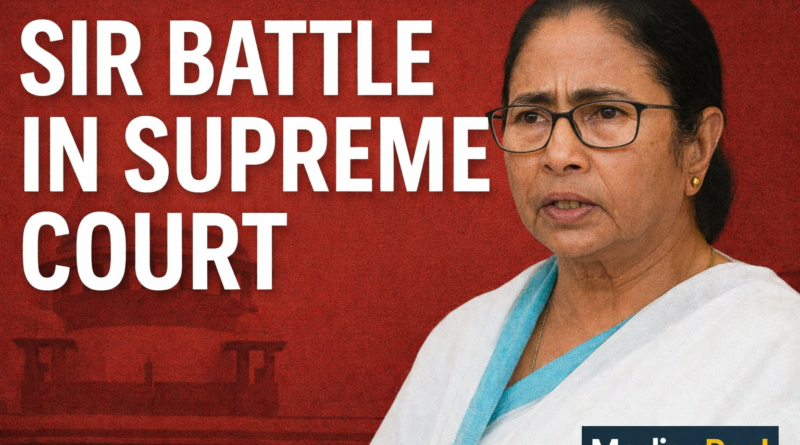
Mamata Banerjee Takes Election Commission Battle Over SIR to Supreme Court
West Bengal Chief Minister Mamata Banerjee has decided to take her fight with the Election Commission of India (ECI) to the Supreme Court, escalating a political disagreement into a full-fledged legal challenge. The dispute centres on the Special Intensive Revision (SIR) of electoral rolls, an exercise that the Trinamool Congress (TMC) believes could have serious consequences for voters in the state.
For days now, Mamata Banerjee has been openly questioning the intent behind the SIR process. Her main concern, echoed repeatedly by TMC leaders, is that large-scale revisions often end up removing genuine voters from the rolls. According to the party, migrant workers, daily wage earners, minorities, and people from economically weaker sections are most vulnerable during such exercises because they frequently lack updated documents.
The Chief Minister has made it clear that she is not opposing voter list revisions in principle. Instead, she argues that the timing and manner of the exercise raise red flags, especially when elections are approaching. By moving the Supreme Court, Mamata Banerjee has signalled that she wants judicial clarity and safeguards to ensure that no eligible voter is disenfranchised.
From Political Protest to Legal Test
What began as sharp political criticism has now turned into a constitutional matter. Legal experts say the petition is likely to question whether the Election Commission has followed due process and whether adequate mechanisms exist to protect voter rights during the SIR exercise.
The Election Commission, however, has defended its actions. It has maintained that Special Intensive Revisions are a routine administrative exercise aimed at cleaning up electoral rolls and removing duplicate or incorrect entries. The ECI has also rejected allegations of political bias, insisting that it functions independently and strictly within the constitutional framework.
Political Reactions Grow Louder
Mamata Banerjee’s move has triggered strong reactions across the political spectrum. Several opposition parties have expressed support, viewing the case as part of a broader fight to protect democratic rights and federal balance. They argue that constitutional institutions must not only be independent but also be seen as fair and transparent.
On the other hand, critics have accused the West Bengal government of politicising an administrative process. They warn that repeatedly questioning the Election Commission could undermine public trust in the electoral system.
Why This Case Matters
As the Supreme Court prepares to hear the matter, the outcome is expected to have implications beyond West Bengal. The court’s observations could influence how voter list revisions are conducted across India, making this a closely watched case in both political and legal circles.