


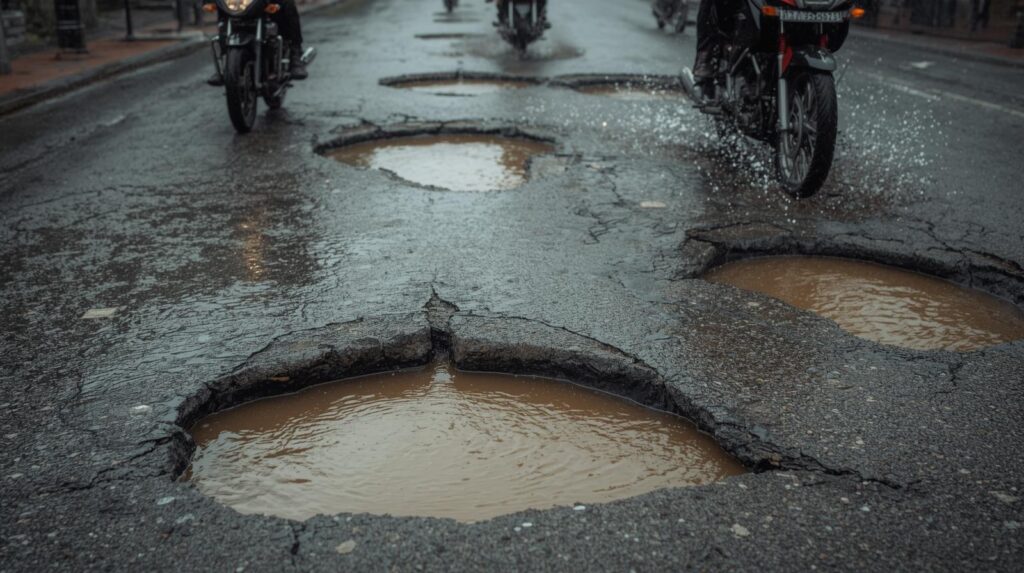

Every year, as the monsoon arrives, potholes begin to appear across Indian roads — from busy highways to narrow city lanes.
It’s a recurring issue that affects millions, but why do our roads fail so easily during rains? Let’s explore the real reasons behind
this annual problem.
- How Potholes Actually Happen (And Why So Many Show Up in Monsoon)
Well, when rainwater seeps into tiny cracks on the road, it doesn’t just sit there — it starts working its way down, slowly weakening
the layers underneath the surface. Then, as vehicles drive over these soft spots, the pressure causes the top layer to break. That’s when
the road gives in — a pothole is ready for damage.
Now during monsoon, this damage happens much faster because:
- Roads stay waterlogged for long hours
- Drainage systems are often blocked or broken
- Constant traffic (especially heavy trucks) keeps pounding the surface
What starts as a tiny crack becomes a dangerous pit in no time. And once it’s there, it only gets worse with each passing vehicle.
- The Real Problem? Weak Construction from the Start
Let’s be honest — a lot of our roads weren’t built to last in the first place.
Many are laid with poor-quality materials, often without a proper foundation. Add to that rushed deadlines and lack
of curing time (the time needed for the road to settle and harden), and you have a road that’s already fragile before the first
drop of rain even hits.
In many places, roadwork is done in a hurry — especially right before elections or just ahead of the rainy season. It may
look good on the outside, but underneath, it’s barely holding together. So when the rains arrive, the surface can’t take the stress
— and it starts to break apart.
- Drainage: The Silent Saboteur
Even a well-built road can’t survive if the water has nowhere to go.
And that’s the story in most Indian cities and towns — the drains are either clogged, badly designed, or simply missing.
Water collects on the roads and stays there for hours, sometimes days. This constant exposure to water softens the surface
and allows moisture to creep into every crack and corner.
A few things that make this worse:
- Poorly maintained or blocked storm water drains
- Roads built without proper slope (so water just pools)
- Unplanned buildings that block natural water paths
In short, the road drowns — and with no way to dry, it dies.
- Corruption & Neglect: The Elephant in the Room
Now comes the uncomfortable part — the role of corruption and lack of accountability.
We’ve all seen freshly repaired roads that don’t last even one season. That’s often because contracts go to the lowest bidder,
not the most reliable one. The focus is on ticking boxes, not doing lasting work.
Here’s what typically happens:
- Repairs are done just to “show” something has been fixed
- No one inspects the quality of work properly
- No action is taken if the same road breaks again within months
It becomes a cycle: build, break, repair, repeat — and who pays for it? The public.
- Monsoon is changing, and so should Our Roads
Monsoons today are not what they were a decade ago. Thanks to climate change, rains are:
- Heavier and more intense
- Less predictable
- Often extended beyond the normal season
A one-hour cloudburst now does the kind of damage that used to take weeks. Flash floods are becoming more common,
and roads just aren’t ready for that kind of stress.
What this means is — even if a road was barely holding up before, the new rain patterns will almost certainly break it down.
- Can We Fix This? Yes — but Not with Quick Patches
This isn’t an unsolvable problem. Other countries with extreme weather have durable roads. India can too — if we’re
willing to move beyond temporary solutions.
This is our call to action for improvement:
- Use better materials that can withstand rain and heat
- Ensure roads are built with proper slope and drainage
- Do quality checks at every stage of construction
- Let citizens report potholes through apps and demand repairs
- Hold contractors accountable if roads break within the warranty period
Some cities are slowly adopting smarter practices — but the gap is still huge.
Conclusion
The solution to the annual pothole crisis in India is straightforward, though politically challenging.They demand requiring higher quality materials, mandatory engineering checks, and above all, zero tolerance for corruption. The time for quick repairs is over. We need fundamental changes, such as using tools like the “Pothole Reporting Apps” reporting app to ensure citizen accountability. Require contractors to adhere to their warranty periods, or be prepared to pay heavy fines. We must demand that new roads be designed to accommodate intense rainfall and climate change. Only when the public presses for better governance and engineering will we pave the way for durable, reliable roads.