


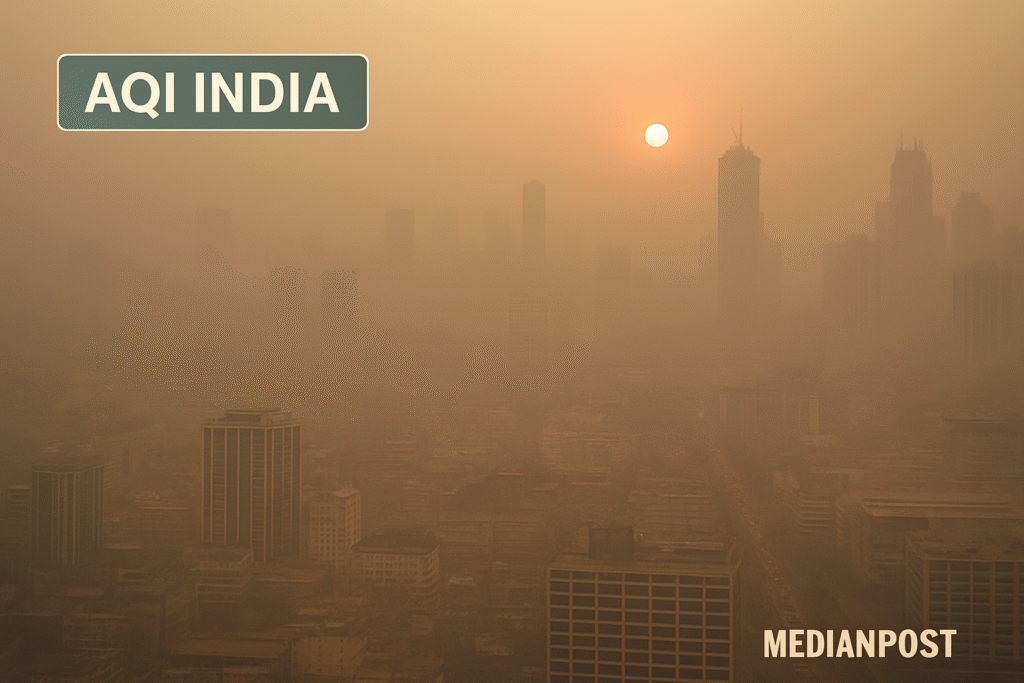
Every winter, India’s Air Quality Index (AQI) turns into a national alarm bell.
Yet, when election season arrives, the same crisis becomes politically irrelevant — almost invisible.
Despite being a public-health emergency, air pollution has failed to transform into a political priority.
And the question that follows is more important: Who is actually responsible?
And why does India never see the kind of climate protests that mobilize people across Europe or the US?
This piece breaks down the political vacuum around India’s AQI crisis.
1.Who Is Responsible for India’s AQI Crisis?
Air pollution is the outcome of multiple systems failing simultaneously.
Here’s the responsibility breakdown:
A- State Governments
State administrations are the closest to the problem — and often the weakest in response.
- Poor urban planning
- Ineffective dust control
- Slow public-transport expansion
- Weak enforcement on waste burning
- Construction regulation failures
State-level negligence directly shapes the “daily” pollution that residents inhale.
B- Central Government
The Centre sets the national framework — and the loopholes are political.
- Weak implementation of national emission standards
- Industry compliance diluted under lobbying pressure
- Delayed transitions to clean energy
- Inability to scale long-term solutions to stubble burning
When the national framework lacks teeth, local pollution becomes inevitable.
C- Municipal Bodies
Municipalities are the frontline defenders — but their enforcement is almost non-existent.
- Road dust
- Garbage burning
- Unauthorized construction debris
- Vehicle congestion
- Lack of local monitoring
Urban AQI is often a reflection of governance failures at the city level.
D- Farmers (and Vote-Bank Politics)
Stubble burning contributes massively to North India’s winter smog.
But no government wants to upset a powerful vote-bank.
Instead of structural reforms, we get political theatrics.
E- Industries & Corporate Lobbies
Industrial emissions continue because compliance hurts profits — and profits fuel politics.
- Brick kilns
- Steel plants
- Coal-based industries
- Chemical units
Political funding and industrial lobbying quietly shape the AQI crisis.
2.Why Foreign Countries Protest Over Pollution — But India Doesn’t
Across Europe and the US, thousands take to the streets demanding climate accountability.
So why doesn’t India witness similar mass movements despite far worse air quality?
Here are the structural differences:
A- Survival Pressures Are Higher in India
Indian citizens face immediate, everyday challenges:
- Jobs
- Price rise
- Basic infrastructure
- Caste/community concerns
Pollution is a “slow, invisible” killer.
Immediate economic pressures overshadow long-term health concerns.
In developed countries, citizens protest because their basic needs are already stable.
B– Low Public Awareness
Environmental literacy is deeply embedded in Western civil society, media, and schools.
In India:
- Many don’t understand AQI levels
- Pollution’s health impact feels abstract
- Media covers air quality only during winter
- Scientific data rarely enters public discourse
Without awareness, mobilization is impossible.
C- India Protests Only on Emotionally Charged Issues
Mass protests in India happen when issues are emotional, identity-driven, or economically threatening:
- Caste
- Religion
- Reservations
- Jobs
- Inflation
Pollution lacks emotional immediacy — it kills silently, not sensationally.
D- Fragmented Responsibility = Fragmented Anger
In Europe, protesters know exactly who to hold accountable.
But in India:
- States blame the Centre
- Centre blames the States
- Farmers blame the government
- Governments blame farmers
- Municipalities blame “local factors”
When responsibility is unclear, citizens don’t know who to protest against.
- Air pollution will gain political significance only if:
- Voters see it as a personal health threat
- Media covers it year-round, not seasonally
- Middle class steps beyond online outrage
- Governments face political cost for inaction
- Clear accountability is established across institutions
Until then, India’s AQI crisis will remain what it is today:
A national emergency without national urgency.