


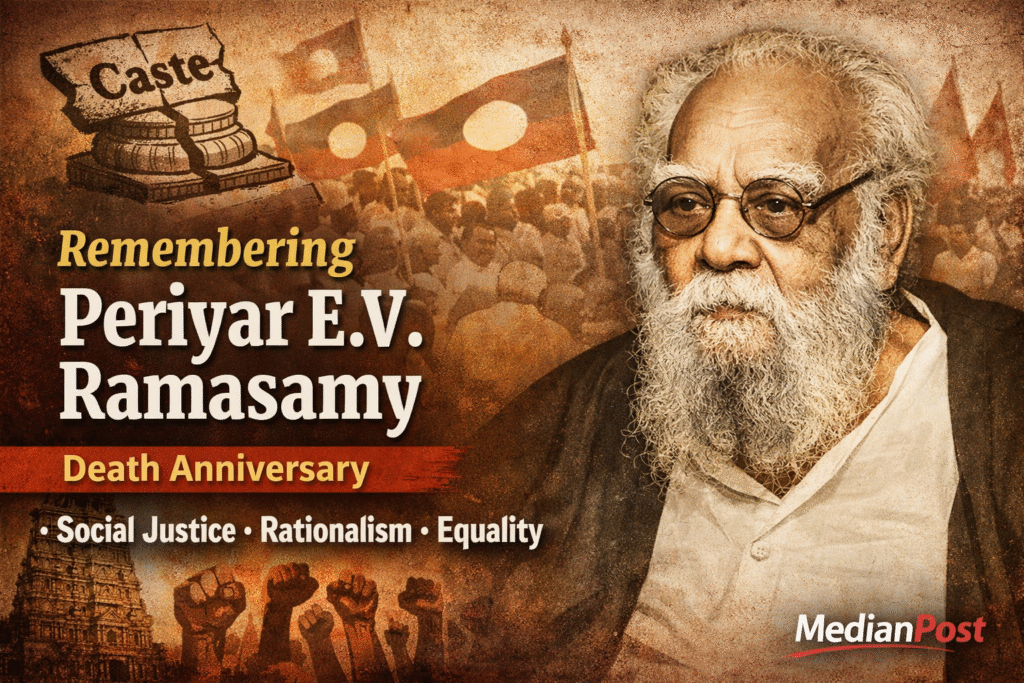
As Tamil Nadu marked the death anniversary of Periyar E.V. Ramasamy on Tuesday, tributes poured in for a leader whose ideas continue to influence social and political discussions even decades after his death. Political leaders, social activists, and Periyarist organisations across the state remembered him as a reformer who consistently questioned inequality and social hierarchy.
Periyar, who passed away on December 24, 1973, is widely regarded as one of the strongest voices against caste discrimination in South India. Born in 1879 in Erode, he rose to prominence at a time when caste divisions were firmly embedded in everyday life. His work focused on challenging these divisions and encouraging people to think beyond birth-based identity.
While the national movement during his time largely revolved around the struggle against British rule, Periyar often stressed that independence alone would not bring real freedom to society. He believed that social reform was equally important and that dignity and equality should be accessible to all.
The Self-Respect Movement
In 1925, Periyar launched the Self-Respect Movement, which became a turning point in social reform in the Madras Presidency. The movement called for rejecting caste-based superiority, questioning ritual dominance, and promoting rational thinking. It also spoke strongly in favour of women’s rights and social equality, ideas that were considered radical during that period.
The movement gradually gained public support and played a key role in shaping social awareness in Tamil society.
Influence on State Politics
Periyar’s ideology later formed the base of the Dravidian movement, which went on to redefine Tamil Nadu’s political direction. Issues such as reservation, social justice, and welfare-oriented governance became central themes in state politics. Over the years, major political parties, including DMK and AIADMK, have acknowledged Periyar’s role in shaping this framework.
Many policies aimed at addressing historical inequality are often linked to the broader social thinking he promoted.
A Leader Who Sparked Debate
Known for his outspoken nature, Periyar frequently criticised religious practices and traditional beliefs that he felt reinforced inequality. These statements often drew criticism and controversy. However, supporters argue that his blunt approach helped break long-standing social barriers and encouraged public debate.
Even critics acknowledge that Periyar succeeded in forcing society to confront uncomfortable questions.
Why He Is Remembered Today
More than five decades after his death, Periyar remains a relevant figure in discussions on caste, social inclusion, and rationalism. His death anniversary serves not just as a day of remembrance, but also as a moment to reflect on how far society has progressed and the challenges that still remain.
Periyar’s legacy continues to live on through the debates he initiated and the social changes he helped set in motion.