


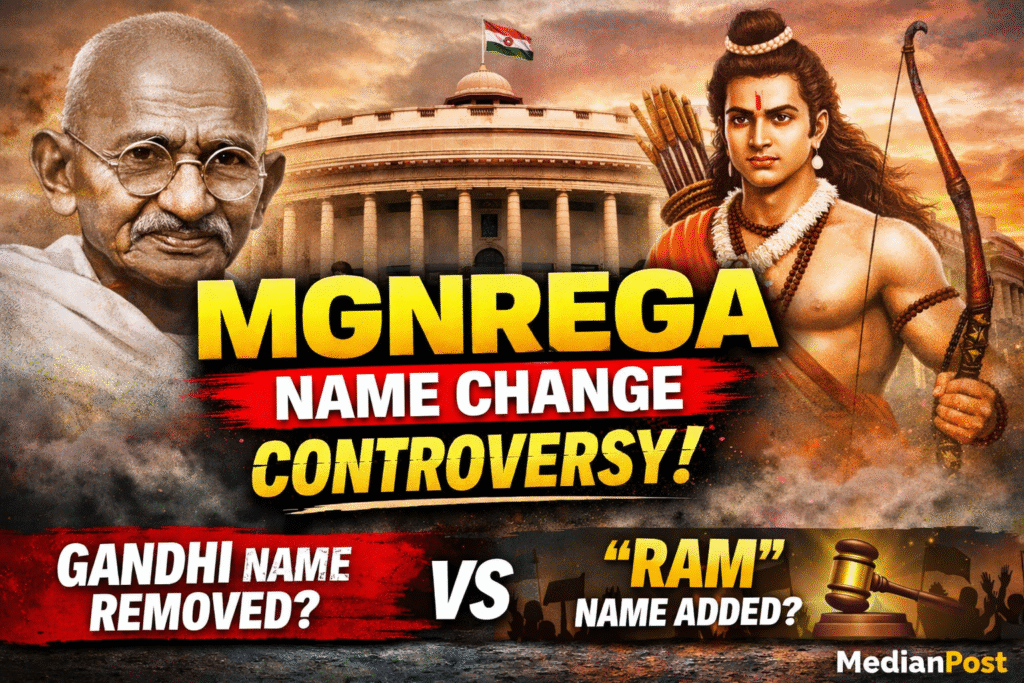
The Centre’s proposal to replace the Mahatma Gandhi National Rural Employment Guarantee Act (MGNREGA) with a newly designed rural employment framework has ignited a fierce political debate in Parliament, with the Opposition raising objections not only over the removal of Mahatma Gandhi’s name but also over the inclusion of “Ram” in the proposed scheme’s title.
During the ongoing Winter Session, the government introduced a bill seeking to overhaul the two-decade-old rural employment programme. MGNREGA, enacted in 2005, guarantees 100 days of wage employment to rural households and is widely regarded as one of India’s most significant social security initiatives.
Government’s Rationale
The government has defended the proposed changes as part of its long-term vision of Viksit Bharat 2047. According to officials, the new framework aims to modernise rural employment by linking it with infrastructure development, productivity enhancement and livelihood creation.
The proposed scheme, tentatively named Viksit Bharat – Gramin Rozgar and Ajeevika Mission (VB-G RAM G), is expected to expand the scope of permissible work and, in certain categories, increase the number of guaranteed workdays. The Centre has maintained that the reform is outcome-oriented and intended to strengthen rural livelihoods rather than weaken welfare protections.
Opposition’s Strong Objections
Opposition parties, led by the Congress, have sharply criticised the bill. While the removal of Mahatma Gandhi’s name has been described as an ideological move, several leaders have also objected to the inclusion of “Ram” in the scheme’s name, arguing that welfare programmes should remain free from religious or cultural symbolism.
Opposition MPs alleged that the naming reflects political branding rather than policy necessity, warning that such symbolism could deepen social divisions. Protests erupted inside Parliament, with leaders insisting that MGNREGA’s identity as a rights-based law should not be diluted or rebranded.
Political Implications
The controversy has quickly expanded beyond legislative debate. With rural voters forming a crucial electoral base, political parties are positioning the issue as part of a larger ideological contest. While the ruling side presents the move as reform-driven governance, the Opposition frames it as an attempt to alter the secular and inclusive character of welfare policy.
Analysts note that changes to MGNREGA have always attracted scrutiny, but the combination of a name change, legacy concerns and religious symbolism has intensified the political fallout.
What Comes Next
The bill is expected to undergo detailed examination in Parliament and by standing committees. Whether the government modifies the proposed name or proceeds with the bill in its current form remains uncertain.
For now, the proposed overhaul of MGNREGA has become a major political flashpoint, reflecting deeper divisions over welfare, ideology and the direction of governance in India.