
“Civic Sense in India: Why Public Discipline Remains a Major Challenge”
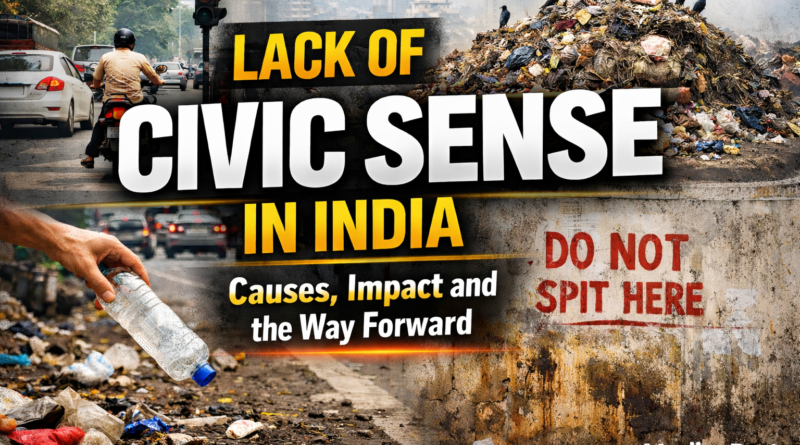
Every morning in India begins with a familiar sight — a freshly cleaned road that slowly fills up with plastic wrappers, traffic signals ignored in a hurry, and public walls stained despite “Do Not Spit” signs. It raises a simple but uncomfortable question: why does civic sense still struggle in a country aiming to become a global superpower?
Development Without Discipline
India has built highways, metro systems, airports, and digital networks at remarkable speed. But development is not just about infrastructure; it is also about behavior. Throwing garbage on the street, breaking traffic rules, damaging public property, or assuming “someone else will fix it” reflects a deeper social habit — a disconnect between rights and responsibilities.
Awareness vs Accountability
The problem is not a lack of awareness. Government campaigns and cleanliness drives have reached millions. Yet awareness without accountability rarely creates lasting change. When traffic violations go unpunished or littering carries no real consequence, discipline becomes optional. Over time, indifference becomes normal.
A Cultural Mindset Issue
Civic sense is ultimately a reflection of mindset. Many Indians maintain spotless homes but show little concern for shared spaces. This contradiction highlights a cultural gap: public property is often treated as belonging to no one, instead of belonging to everyone.
The Way Forward
Real change must begin early — in schools, in families, and through consistent enforcement of laws. Civic responsibility should not be seen as moral preaching but as a basic social duty. A nation’s progress is not measured only in economic growth, but in everyday discipline. If India truly wants global respect, civic sense must move from slogans to habits.