


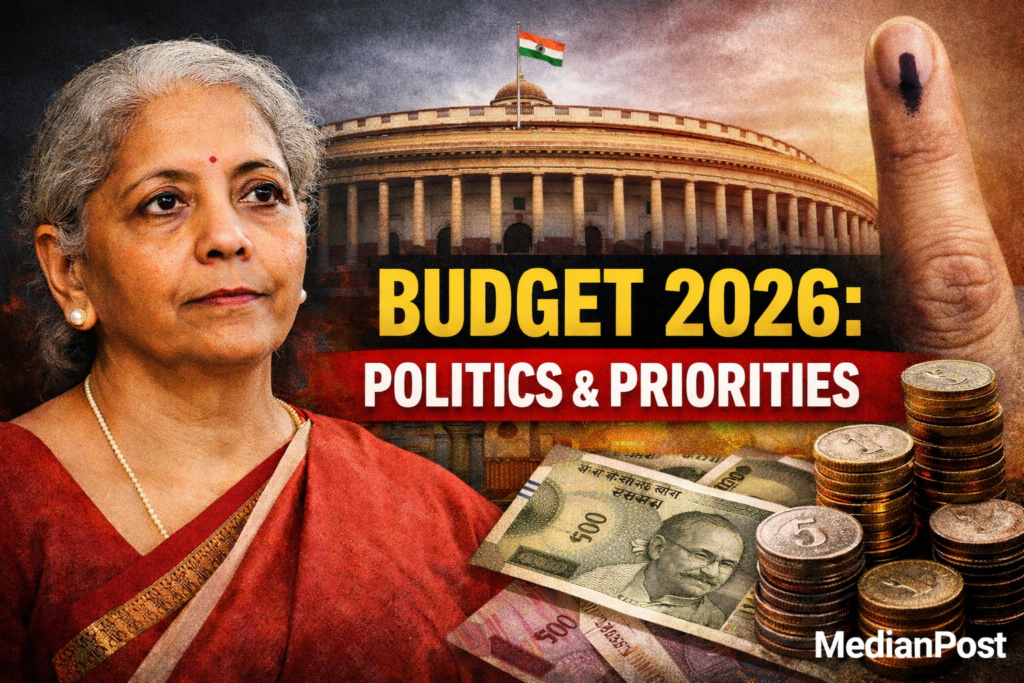
India’s Budget 2026 is expected to be more than a financial roadmap it is shaping up as a key political document. With the country moving closer to a crucial election phase, every allocation, tax decision, and welfare announcement will be seen as a political signal. For the government, this budget is about strengthening public trust while defending its economic record.
Managing Inflation Without Losing Voters
One of the biggest political pressures behind Budget 2026 is inflation. Rising food prices, fuel costs, and household expenses continue to affect ordinary citizens. Politically, ignoring this pain is not an option. The government is expected to rely on targeted subsidies and welfare support rather than broad giveaways, allowing it to project fiscal responsibility while still addressing voter concerns.
Middle Class and Tax Expectations
The middle class remains one of the most politically vocal groups in India. Expectations of income tax relief, higher standard deductions, and simplified tax slabs are high. Even small tax adjustments can carry strong political messaging, especially for urban voters. A budget that offers visible relief could help the government reinforce its image as middle-class friendly.
Infrastructure as a Political Weapon
Infrastructure spending is likely to remain a major focus in Budget 2026. Investments in highways, railways, metro projects, and digital connectivity are not just economic drivers they are political assets. Large infrastructure projects allow the government to showcase development on the ground, strengthening its narrative of long-term growth and governance efficiency.
Farmers, Rural India, and Electoral Arithmetic
Rural voters continue to play a decisive role in Indian elections. Budget 2026 is expected to address farmer income, crop insurance, irrigation, and rural employment schemes. Politically, even modest increases in agricultural support can have a significant impact on voter sentiment, particularly in states where rural distress remains high.
Centre–State Relations and Political Messaging
Budget allocations to states will also be closely watched. Opposition-ruled states may accuse the Centre of bias, while the government is likely to emphasize cooperative federalism. These debates often go beyond economics and become central to political narratives around fairness and power sharing.
Opposition’s Narrative and Political Battle Lines
The opposition will scrutinize Budget 2026 for gaps unemployment, inequality, or cuts in social spending. Whether the budget is framed as “pro-people” or “election-driven” will depend on how effectively the government balances growth with welfare.
Setting the Political Tone for 2026
Ultimately, Budget 2026 will help define the political mood of the year. Beyond balance sheets, it will reflect priorities, intent, and electoral strategy making it one of the most politically significant budgets in recent years.