


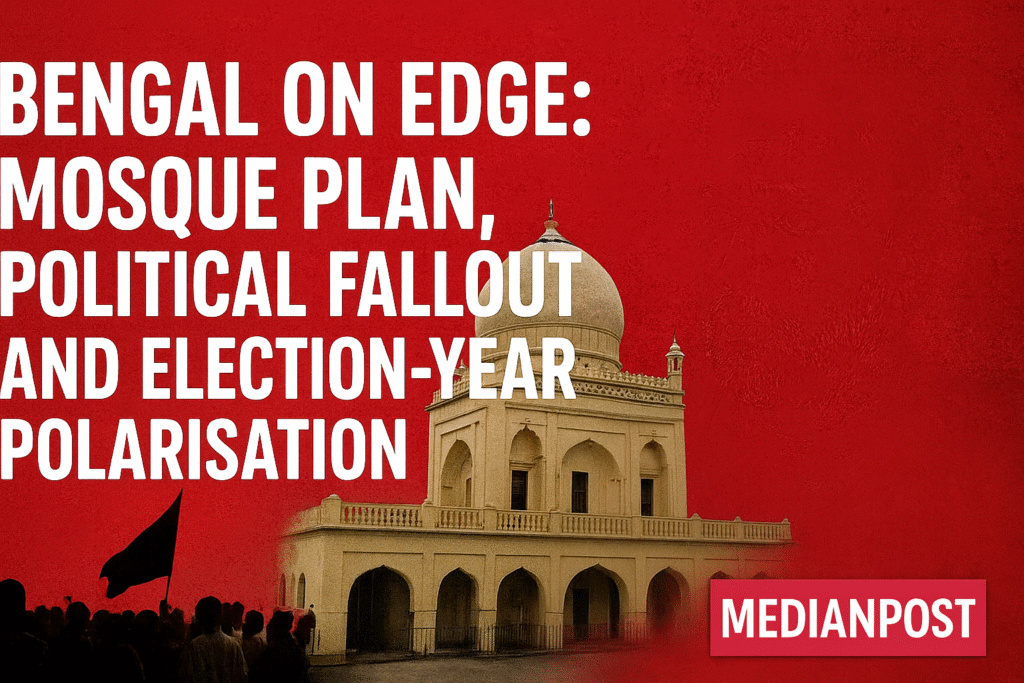
Kolkata / Murshidabad: As West Bengal moves closer to its next assembly elections, a controversial move by a rebel legislator has stirred communal and political tensions a development that could reshape electoral narratives across the state.
What Happened: Mosque Plan & Foundation Laying
On 6 December 2025, Humayun Kabir once a legislator of the Trinamool Congress (TMC), now suspended laid the foundation stone for a mosque in Beldanga, Murshidabad, claiming it would be a “Babri Masjid-style” structure.
The date chosen carries symbolic weight: 6 December marks the anniversary of the demolition of the original Babri Masjid in Ayodhya.
Kabir has also stated that the project is not just a mosque but a large religious and social complex that will include facilities like a hospital, college, and rest house. The land area proposed is reportedly significant.
Political Fallout: Suspension and New Party Talk
Following his announcement, TMC suspended Kabir, accusing him of indulging in “communal politics” and violating the party’s stated secular line.
Despite warnings from party leaders, Kabir moved ahead with the event.
He has since declared that he plans to launch a new political outfit by 22 December, and aims to contest around 135 seats in the coming assembly polls.
Authorities claim that Kabir did not obtain complete formal permissions for the foundation ceremony, raising questions about legality, public safety, and the potential for communal flare-ups.
Security, Court and Communal Concerns
Security was tightened across the Beldanga Rejinagar region. Local police, Rapid Action Force (RAF), and central units were deployed.
Key roads including sections of National Highway 12 were temporarily restricted.
A petition seeking to stop the foundation-laying reached the Calcutta High Court.
While the court did not block the event, it directed authorities to maintain strict law and order, placing responsibility on the state administration should any unrest occur.
Opposition voices and critics argue that the mosque project is politically timed that it aims to influence religious identities ahead of the election.
Some warn that such moves, intentionally or not, could deepen communal divides.
Political & Electoral Angle: Why Now?
With elections nearing, political observers see this development as part of a larger pattern in Bengal the use of religious symbolism and identity politics to mobilise votes.
In minority-majority districts like Murshidabad, the timing and narrative around the mosque’s foundation carry added significance.
Analysts say it could directly impact voter behaviour in several tight constituencies.
Kabir’s decision to form a new party and contest a large number of seats suggests he plans to convert this controversy into political momentum.
Public Mood & Risks Ahead
Thousands reportedly gathered at the ceremony, with some supporters contributing funds.
But alongside enthusiasm, there is widespread concern over:
- rising communal tension
- potential clashes
- political exploitation of religious sentiment
- possible long-term divisions
Community groups and civic leaders have urged all sides to avoid turning places of worship into political instruments.
They stress that religious construction should be based on social need and community benefit not campaign strategy.
Religion, Politics and the Fine Line of Democracy
The events unfolding in Murshidabad highlight how sensitive and volatile the intersection of religion and politics remains especially in an election year.
What started as a plan to build a mosque has evolved into a major political flashpoint, raising questions about communal harmony, governance, and the future of electoral ethics.
As West Bengal prepares for the polls, the key question is clear:
Will voters prioritise real development and governance, or will polarising narratives shape the state’s political future?