
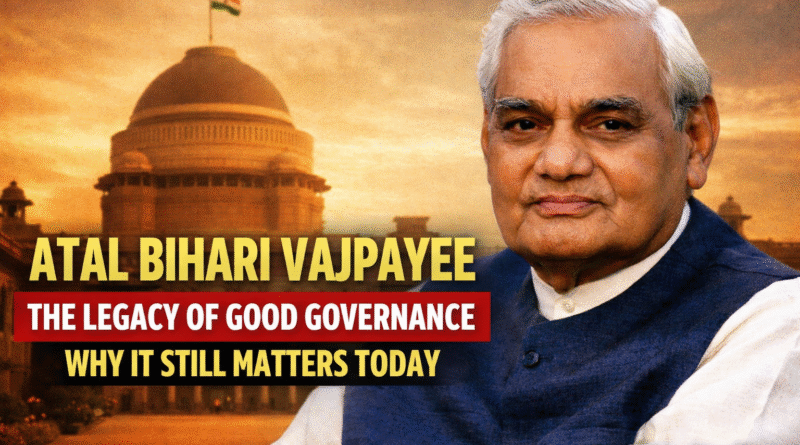
Atal Bihari Vajpayee: Why His Idea of Good Governance Still Matters Today
When Politics Spoke Softly
Indian politics today thrives on volume sharp statements, instant reactions, and constant confrontation. In this environment, remembering Atal Bihari Vajpayee feels like recalling a different political culture altogether. He was a leader who did not need aggression to assert authority. His strength lay in composure, and his politics spoke more through conduct than confrontation.
Governance Was a Moral Responsibility
Vajpayee treated power as a responsibility, not a weapon. Even while leading unstable coalition governments, he avoided turning political disagreement into personal hostility. He believed governance was not about defeating opponents but about managing diversity of opinion. That belief allowed democracy to function without fear or intimidation, something that appears increasingly fragile today.
Institutions Came Before Politics
One of Vajpayee’s most underappreciated contributions was his unwavering respect for democratic institutions. Parliament mattered to him not as a stage for disruption, but as a forum for reasoned debate. The judiciary was respected even when its decisions were inconvenient. Vajpayee understood that weakening institutions for short-term political gain ultimately weakens the state itself.
Development Without Drumbeats
Unlike today’s politics of constant branding, Vajpayee’s development agenda unfolded quietly. Projects like the Golden Quadrilateral highways reshaped India’s economic connectivity without daily publicity campaigns. Roads were built, regions were linked, and economic movement improved. Vajpayee believed governance should be felt on the ground, not sold through repeated slogans.
Diplomacy Chosen Over Chest-Thumping
In foreign policy, Vajpayee showed that confidence did not require hostility. His Lahore bus journey remains one of the strongest political statements of intent in India’s diplomatic history. While peace efforts faced setbacks, the willingness to talk itself reflected maturity. Vajpayee proved that dialogue is not surrender it is strategy.
Why His Idea Feels Missing Today
Good Governance Day, observed on Vajpayee’s birth anniversary, is meant to remind India of these principles accountability, transparency, and citizen-first administration. Yet its deeper significance lies in what feels absent today. Politics increasingly prioritises narrative control over administrative outcomes, and loyalty over competence.
The Human Behind the Leader
Vajpayee was also a poet, a quality that shaped his politics. He understood doubt, restraint, and emotion traits rare in power corridors. That human sensitivity allowed him to disagree without demeaning, to govern without arrogance, and to lead without fear.
Closure
Atal Bihari Vajpayee’s idea of good governance matters today because it offers a mirror to the present. It asks uncomfortable questions: Can power exist without hostility? Can governance function without constant polarisation? Remembering Vajpayee is not about glorifying the past it is about recognising what Indian politics has gradually lost, and what it still has the capacity to recover.