
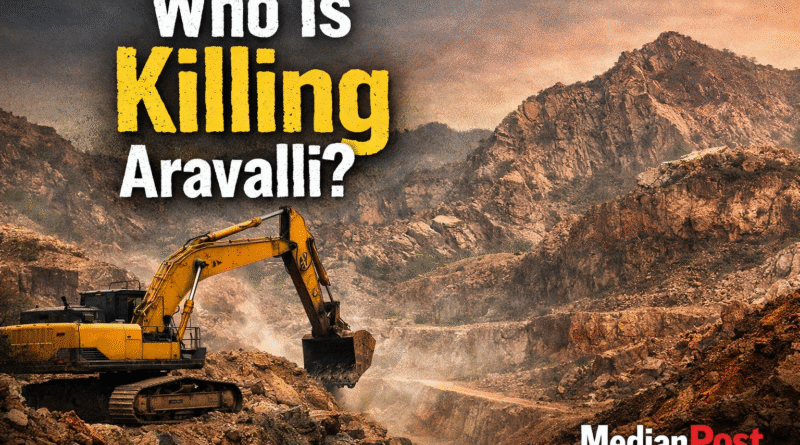
Aravalli in Crisis: Illegal Mining and Official Apathy Threaten India’s Oldest Mountain Range
Destruction in Plain Sight
The Aravalli range has stood for millions of years, silently shaping the ecology of North India. Today, its hills are scarred, dust rises where forests once stood, and the cries of local communities go largely unheard. Illegal mining and unchecked construction are steadily dismantling India’s oldest mountain system, stretching across Rajasthan, Haryana, Delhi, and Gujarat. What is more alarming is not just the environmental damage, but the seeming inability or unwillingness of authorities to enforce the law.
Law on Paper, Destruction on Ground
The Supreme Court and the National Green Tribunal (NGT) have repeatedly marked large parts of the Aravalli as ecologically sensitive and banned mining in these zones. Yet, residents report that blasting and stone transportation continue unabated. “Mining never really stopped. It only shifted to night hours,” says a farmer from southern Haryana, pointing at trucks rumbling past his home in the dead of night. In Rajasthan, locals say enforcement teams arrive briefly, only for operations to resume the next day. The law exists, but for many, it feels like a distant promise.
Apathy and Political Shielding
Environmental groups allege that illegal mining thrives under a protective cover of administrative apathy and political shielding. Forest clearances are delayed or diluted, violations go largely unpunished, and land classifications are quietly altered to facilitate commercial activity. According to activists, these are not isolated cases but part of a systematic neglect that allows mining mafias to operate with impunity.
Urban Expansion Intensifies Pressure
Rapid urban development around Gurugram, Faridabad, and adjacent areas has placed additional stress on the Aravallis. Roads, housing projects, and commercial infrastructure encroach deep into once-protected forest lands. Critics question how such projects continue to get approvals when environmental regulations and court orders clearly prohibit activity in these sensitive zones.
The Price Paid by Citizens
The real cost, however, is borne by ordinary citizens. Groundwater levels in communities near the Aravallis have fallen sharply, forcing deeper and more expensive drilling. The hills’ role as a natural barrier against desertification is weakening, raising fears that the Thar Desert could expand eastward, threatening local livelihoods and agriculture. Delhi–NCR’s worsening air pollution is also linked to the degradation, as the hills can no longer block dust and particulate matter that now spreads freely into the capital.
Irreversible Damage Looms
Scientists warn that continued mining and deforestation could soon lead to irreversible ecological damage. Loss of vegetation increases flood risk during heavy rains and extreme heat during summers. “This is not just an environmental issue it is a governance failure with long-term consequences,” says an environmental policy expert.
A Test of Governance and Will
Government agencies point to inspections, fines, and demolition drives. Yet activists argue these actions are selective and reactive. The Aravalli crisis forces a difficult question: if court orders exist and scientific warnings are clear, why does destruction continue?
As India positions itself as a leader in climate action, the fate of the Aravallis offers a sobering reality check. Once destroyed, these ancient hills cannot be restored. The coming years will reveal whether authorities have the political will and accountability to save one of India’s most precious ecological assets or let it disappear forever.